A Roots Music Sacrifice: A Review of Matisyahu's Akeda

Netanel Miles-Yépez

In the world of reggae, there is "roots music" and "dancehall music." Dancehall music is like it sounds, popular music to get you up and dance. No message necessary. Whereas roots music digs into the life of the artist—revealing troubles and spiritual trials—and occasionally delivers a message of hope and inspiration. Matisyahu, the Jewish singer-songwriter, who first achieved notoriety as a Hasidic reggae artist with a hip-hop style and inspiring Jewish lyrics, is generally known for both. And though he has long since shed his exclusively Hasidic reggae identity, he has continued to make what is essentially great dancehall music with an underlying message—that is, until now.

Matisyahu's new album, Akeda, is almost pure roots music, with a little dancehall sprinkled in the mix. It's the kind of album you put on when you need to get away, or shut the bedroom door and just kick-back, soaking in the music. If his previous album, Spark Seeker, was like a joyful leap into the mosh-pit at Red Rocks on a sunny day, Akeda is all on the ground, like a slow walk through lonely streets in the early morning or at night, letting one's thoughts churn with every step. It is music that comes from the inside-out, and that somehow makes you feel cleansed in the listening.

In all of his studio albums, Matisyahu has made a hallmark of daring creativity, and has demonstrated a unique ability to integrate diverse musical influences into his sound. He never plays it safe. Every album is a new musicaland spiritual—exploration; and because of this, he has sometimes disappointed his more genre-oriented fans who tend to pine over the "good-old-days" when he seemed to be a reggae super-star and Jewish icon. But no true artist can live in a box, any more than every fan of one period in an artist's life can follow them into the next. In the end, the artist creates for those who can hear the deeper melody, changing and evolving through each period, the same melody that haunts them and has to be delivered from within.

Akeda is the kind of album an artist makes when there is no other creative choice but to turn oneself inside-out, to scrape the insides and reveal everything raw. Past albums begin to feel like masks and a burden; successful collaborations with great producers—with their own vision for the music—begin to hang like a weight around an artist's neck. Something inside chafes at all the little incursions into the music, at the add-ons that sometimes work . . . and sometimes don't. In the end, there is no choice but to take back control and look for the original purity amid all the static. This impulse is what makes Akeda Matisyahu's most self-reflective and purely conceived album.

Like Marvin Gaye's radically experimental What's Going On in 1971, Akeda breaks all the conventional rules and reveals the musician behind the recording artist. A musician's musician, Matisyahu often seems to be singing in a backroom jam session with friends, or in some small, smoky venue trying to get a tiny crowd into a groove he's feeling in the moment. Many songs on Akeda have a quality reminiscent of those many great Bob Marley songs that get lost amid the anthems and "greatest hits." Matisyahu respects the music and isn't afraid to let a song find its own way. Not enslaved to catchy hooks and refrains, many songs on Akeda grow and open-out organically in new and unexpected ways; like life, they walk and fall down and get back up, and sometimes find that they can soar. There is also a driving, soulful undertone in them, delivered with a light touch and an obvious delight in letting the music be what it wants to be—regardless of fan expectations.

Paralleling the best music of the 1970s (and occasionally the 80s), Akeda is an album with easy, ambling rhythms, soulful and searching lyrics, and oddly playful effects—horns jumping in at unexpected moments to lighten the mood—totally renewing and reinvigorating that great sound from the past. The first track, "Reservoir," is the perfect tone-setter for the album, with its Dylan-esque walk through a host of edgy, painful emotions, full of fight and building to its own defiant brand of gratitude. Then, in "Watch the Walls Melt Down," a contrastingly meditative and triumphant song, Matisyahu achieves another brilliant musical fusion, created from equally complex emotions—watching your life fall apart, almost urging its destruction so you can start rebuilding. Struggles with inner demons and loneliness compete with an equally strong determination to love and rise from the ashes in many songs, like "Obstacles" and "Hard Way" (a personal favorite on the album). These themes are not new to Akeda, of course, but take on a much more personal and poignant tone in it. And yet, even as the album heads into new places musically, and in terms of its contemplative depth, it is still built on the foundation of Matisyahu's previous work and early influences. For those fans who missed his reggae sound in Spark Seeker, it makes a powerful return in Akeda. Indeed, the new song, "Black Heart" may be the most mature feeling reggae in the Matisyahu catalogue, having all the makings of a reggae classic. Likewise, the uplifting anthem "Champion" will delight as much as the questioning and reflective, "Confidence," with its easy reggae pop and beat.

But underneath all the externals of style, feeding this very personal "roots album," is the idea of sacrifice. In the Jewish tradition, akeda is a reference to the "binding" of Isaac on the rock of sacrifice—bound by his father, Abraham, in accordance with God's command. But unlike Judaism's traditional emphasis on Abraham's great faith and the reward for that faith, Matisyahu's Akeda is an exploration of the great "toll" such acts of faith take on one's life. Whether one is called to be an artist or a spiritual servant like Abraham, whether one is driven to follow the demanding call of one's muse or one's God, there is no promise of perfect happiness, no perfect life for the servant of the call—even if one is successful in following it. After all, what happened to Abraham's relationship to his son and his wife after the akeda? Some Jewish traditions tell of tragedy in the aftermath. Perhaps that is what was really sacrificed in his following God's command. Often, we do what we must, driven by the call from within; but it isn't always pretty. Matisyahu's Akeda is ultimately a Kierkegaardian contemplation on the aftermath of this act of faith, of answering the divine call, ayeka?—"Where are you?"—and how it is possible to find solace, and even a sense of wholeness amid the brokenness of the sacrifice.

Matisyahu’s “Akeda”

By Netanel Miles-Yépez

The Grammy Award nominated artist, Matisyahu, has come a long way since 2005 when he released his breakout album Live at Stubb’s (which reached #1 on the Reggae Albums Chart and #30 on the Billboard 200). Since then he has proven to be one of the most dynamic and creative artists in the industry today, breaking with convention at every turn and remaking his musical image with nearly every album. And his latest—Akeda (Uh-kay-duh)—is no different in this regard.

What is different is Akeda’s depth and naturalness; it is by far Matisyahu’s most personal album, and the one over which he has had the most creative control. Comparable to Marvin Gaye’s 1971 classic, What’s Going On, “Akeda is the kind of album an artist makes when there is no other creative choice but to turn oneself inside-out, to scrape the insides and reveal everything raw.” . . .  “Akeda breaks all the conventional rules and reveals the musician behind the recording artist.”

Though he achieved early success as a “Hasidic reggae super-star,” Matisyahu—the man and the musician—soon began to chafe under the constraints of that label and the projections that went with it. The music was continuing to evolve, and so was his spiritual identity. Reggae was just one strong influence in the sound he was seeking; and the mystical teachings of Hasidism had soaked-in to a degree that he felt the external trappings were no longer necessary. As he says on the new album, “Got it on the inside, don’t need to wear it out.”

By the release of Spark Seeker in 2012, Matisyahu’s appearance and sound had changed drastically from the days of his first success. And though his music was more successful than ever, having an even broader, multi-influence, cross-genre appeal, the backlash from his early reggae-oriented fans, and those who saw him as a “bearded Jewish icon” was overwhelming and deeply painful to him. The pressures of success and constant touring, coupled with this onslaught of superficial criticism, drove the singer into the intense feelings of isolation and introspection that eventually resulted in Akeda, his most “self-reflective and purely conceived album” to date.

Written on tour, and in his Los Angeles home, Akeda was recorded in Brooklyn’s Studio G with his touring band, Dub Trio (Dave Holmes, Stu Brooks, and Joe Tomino), and was personally produced by Matisyahu and bassist, Stu Brooks (with assists from Studio G owner, Joel Hamilton, and Dave Holmes). Matisyahu also worked on a number of tracks with long time friends and collaborators, Aaron Dugan, Rob Marcher and Mark Guilana.

When asked about the writing and recording process for Akeda, Matisyahu says: “On this record, I really just wrote from my guts. I wanted everything to come from the inside . . . I didn’t want to make any compromises with the music or the recording process. It was all done at my place, or at Studio G with my bass player, Stu Brooks, who produced the record. Our musical tastes are so similar, and we’ve been working together so long, there was no need to go out looking for the ‘right producer’ or the ‘right beat’ . . . Everything just came to us, and it was always right on the money.”

The result of this collaboration is a wide-ranging, radically experimental album that adds a new layer of sophistication to Matisyahu’s oeuvre. While in past albums, Matisyahu’s songs and lyrics were often drawn from inspiring themes and teachings in Hasidic Judaism; in Akeda, the lyrics are far more personal and Hasidic ideas play a smaller, supporting role. “They’re definitely in there,” says Matisyahu, “but they’re a lot more integrated than before. In some ways, I think I used to disguise myself behind them. But on this album, I was able to step into the world more, to come out from behind the glass and write more emotional songs, dealing with the real events and people in my life. And when I did this, I found that all the Hasidic and kabbalistic ideas I’ve studied for years came up naturally and were able to enter into my real life.” 

This is clear throughout the album, especially in intensely personal songs like “Reservoir.” In talking about this song, Matisyahu says: “In that song, I’m really dealing with the pain I felt—and continue to feel—from my ‘brothers’ who were so quick to throw me under the bus because of my changes. As usual, I make a lot of references to stories and motifs from Torah; only now, they are more internalized and deeply personal. The title, ‘Reservoir,’ refers to the reservoir in Central Park that I’ve found myself walking around at different times in my life. One day, it occurred to me that I’d never gone all the way around it, never completed the circle. It made me realize how much I wanted closure and a sense of completeness in my life.”

Another important song for Matisyahu is “Broken Car,” which sets up a theme found throughout the album. “This is really a song about refuge,” says Matisyahu, “about finding a home in the world; it’s about acceptance of oneself and others—with all the problems and flaws. It comes from the sense of profound ‘brokenness’ I’ve experienced in my own life over the past few years, which I’ve come to look at without judgment, with a kind of acceptance, patience and love. At this point, I just want to be grateful to God for the blessing of being able to continue growing and doing what I can to create a place of healing in this broken world.”

This, of course, brings us to Akeda, the album’s title. Akeda (‘binding’) is a Hebrew word that refers to sacrifice, or rather the near-sacrifice of Isaac by his father Abraham in the Bible at God’s command. But for Matisyahu, it is also a powerful symbol for the “toll” such acts of faith take on one’s life—even for a musician following his own heart and musical instincts. The success of “following the muse” brings its own problems, forcing an artist to look deep inside for the original purity that gave life to the music in the first place. This is the theme that shapes Akeda; for the songs on this new album deal with the intense loneliness and isolation of life on the road, processing complex feelings of betrayal from former friends and fans, as well the breakdown of longstanding relationships. But far from wallowing in these feelings and trials, the songs on Akeda deal with them, exploring them in the depths, and finally find their way back to the surface, where they achieve a kind of wholeness amid the brokenness of the sacrifice. In the end, “It is music that comes from the inside-out, and that somehow makes you feel cleansed in the listening.”*

* Some quotes are taken from my upcoming album review, “A Roots Music Sacrifice: A Review of Matisyahu’s Akeda.” Huffington Post.

A Review of Taqwacore: The Birth of Punk Islam

By Robert Tesar

Muhammad was a punk rocker

you know he tore shit up

Muhammad was a punk rocker

Rancid sticker on his pickup truck

    -- Michael Muhammad Knight

Taqwacore: The Birth of Punk Islam documents the living manifestation of Michael Muhammad Knight’s fictional account of a Muslim punk house in Buffalo, New York. Knight’s imagined Islamic punk scene, as depicted in The Taqwacores, has become somewhat of a manifesto for young punk American Muslims.[1] Carl W. Ernst, Professor of Islamic studies at the University of North Carolina, has even suggested that The Taqwacores is the Catcher in the Rye of young Muslims.[2] Specifically, the book spoke to a number of young American Muslim musicians and caused many of them to reach out to Knight and other Islamic punk youth across North America. Consequently, in 2007, several Islamic punk rock bands, along with Knight, set out across America in hopes of performing at various venues and eventually ending up in Chicago at the gathering of the Islamic Society of North America (ISNA).

Before viewing the film, I wondered how a punk ideology and Islam could possibly coexist. It did not take much contemplation before I became aware that both perspectives are married by the feeling of being disenfranchised. The American Islamic punks are part of a counter-culture seemingly even more “counter” than other punk movements of the American musical scene. In this way, they are somewhat of a counter-counter culture. I don’t intend to negate one counter with another; I only want to suggest that this cultural phenomenon is the conglomeration of two fringe cultural groups, making the Islamic punk scene a very interesting anti-establishment phenomenon. These Muslim artists are not only reacting to American culture, they are also questioning Islamic doctrine, as well as engaging the tensions that have developed between American Muslims and certain populations of fearful Americans who are cultivating anti-Muslim sentiment. One featured band in the documentary, The Kominas, articulate this layered struggle in their song, “Sharia Law in The U.S.A”:

"I am an Islamist, I am the antichrist, most squares can't make most wanted lists, but my my how I stay in style, cops chased me out of my mother's womb, my crib was in state pen before age two and the feds had bugged my red toy phone, so I devised a plan for heads to roll . . ."

With such provocative lyrics, it is hard to conceive of how such music might bridge the gap in understanding between cultures. But Michael Muhammad Knight makes a point of saying that this movement is sticking the middle finger up to both Islam and America.

The film begins with glimpses of dirty crowded beer-stained basements full of sweaty ecstatic kids, not all that different from scenes shown in The Decline of Western Civilization, a film that documented the beginnings of the punk scene in the early eighties. However, in Taqwacore: The Birth of Punk Islam, the crowd is composed of young women in hijabs (veils that cover the head and chest, most often worn by Muslim women) and young men wearing taqiyahs (short, round, brimless hats worn by Muslim men). This is not to say that all of the audience is dressed in this way, but enough to note. 

In such a scene, Islamic rapper, MC Riz calls the listeners to “investigate just what it says, fast, help the poor, and pray God, Mecca, feast, fast and faith, that’s the basics, that’s the base, so how did we get here today?” It might be in such a way these youth have a new way to contemplate the Qur’an, the Five Pillars of Islamic practice, and more broadly, Islam and its integration into a global community.

As the intrepid tour moves from Boston towards their final destination, Chicago, it is very apparent their journey will not be an easy one. Their touring vehicle is an old school bus that has been painted green and decorated with images that cause the contemplative to engage the struggle which exists in the message of the musician’s music.

Kim Badawi, “On the Taqwa bus”, Muhammad Rocked the Casbah, Texas Observer, 14 December 2007.

Kim Badawi, “On the Taqwa bus”, Muhammad Rocked the Casbah, Texas Observer, 14 December 2007.

In Brooklyn, New York, the bus is pulled over because it is thought to be carrying tanks of propane. At a later point in the tour, one of their shows is cancelled due to certain graphics on a concert poster. The climax of the tour takes place at the Islamic Society of North America meeting in Chicago when the bands play the student’s open mic’ night.

After a number of spoken word performances, the bands take the stage to share their Islamic Punk music with their peers. The first band to perform, The Secret Trial Five, led by Canadian Muslim lesbian drag king, Sena Hussain, immediately causes an uproar due to the fact women are not allowed to sing at the so-called “open” mic. Eventually, the police show up and ask the bands to leave the gathering. Adding to the spectacle, in punk fashion, they do not leave without exchanging a few words with the law. As they leave the building, it becomes ironically apparent that one of the musicians prophetically wears a t-shirt that reads, “Frisk me I am Muslim.”

The second half of the film shares the journey of Basim Usmani and Shahjehan Khan as they travel to Pakistan, attempting to bring punk to the Islamic nation. The duo is eventually met by Knight, who at age seventeen had spent a year studying at the Faisal Mosque in Islamabad. This portion of the film shows Usmani’s and Shahjehan’s struggle to play shows for the Pakistani public. Though, the difficulty to get and play shows seems at least partly due to their habitual use of hash.

While in Pakistan, Knight, Usmani and Shahjehan travel to Shah Jamal, a Sufi shrine, where Sadhu-looking Sufis chant, spin, and play music in praise of Allah, great and glorious is He. In one interview, a white bearded Sufi teaches Knight that Allah is a dervish (Sufi beggar). So maybe He is also a punk rocker?

When the duo play a show in Islamabad, they are received with different reactions, many of which are quite positive. I found it very interesting that a couple of the men who were interviewed wore t-shirts celebrating, respectively, Led Zepplin and the iconic Che Guevara. While Led Zepplin and Che are not “punks”, they certainly embody an attitude that goes against the mainstream and allowed the punk movement to take shape.

One of the most powerful scenes depicts a large group of shirtless men at the Shi’i shrine Bibi Pak Daman, banging their bare chests in a thunderous boom, causing their flesh to tear and bruise. Knight participates in the ritual, while his two friends hang out in the back of the room surrounded by other men who have decided to keep their shirts on and drum lightly on their breasts.

After many late nights of hash smoking, Knight is confronted with questions regarding his Muslim identity and his connection to Pakistan, so he leaves the two rockers and heads out to try and see the Pakistan he missed during his last stay in the country.

Alone, Knight travels back to the Faisal Mosque. There we see him partake in wudhu (the ritual cleansing or ablution that is done before prayer). I was surprised to see the many wudhu stations that surround a portion of the Mosque. It was clear that the mosque could accommodate a great number of Muslims. At the Mosque, he meets with an Imam who is very pleased to learn of Knight’s status as a Muslim, saying to Knight, “How lucky!”

After Knight returns to his partying Taqwacore pals, they decide to try and put on a free concert in the red light district. Their efforts result in quite the success and it seems that punk music has found a place in Pakistan.

I enjoyed this film. It examines an Islam that seems to be, in appearance at least, much different than what we have studied in the past. However, as the film progressed, I was able to recognize the sentiment of the shahadah the Islamic creedal statement, “there no God but God”, and the tawhid, the oneness that exists within the punk paradigm. Punk rock, even in all its dirt, grime, and anti-authority ideology, is not outside of God and religion.

The attitude of taqwa, with which this sub-punk genre has aligned itself, suggests a “reverence” or “piety” that has been interpreted as God-consciousness. I believe this is a fitting mission for those who participate in the Taqwacore movement. It is impossible to place limits on the Creator, so to try and suggest these artists are outside of the manifestation of God, seems ill-informed and quite subjective. In this way, Taqwacore: The Birth of Punk Islam, opened my heart and mind to an Islam quite different than anything I might have imagined, affirming the greatness of God’s manifestations in our lived experience, because it is only God, according to Islam, that will judge us on the Day of Reckoning.


Notes

1. Taqwacore -- a subgenre of punk music that relates to Islam. The term was first used by Michael Muhammad Knight in his novel The Taqwacores (2003. The word is composed of the Arabic word taqwa, meaning “piety” or “God fearing” and “hardcore” another subgenre of punk music that is usually faster, heavier, and more abrasive than other forms of punk.

2. Christopher Maag, “Young Muslims Build a Subculture on Underground Book”, The New York Times, 22 December 2008.

Sefarad — A Short History of the Crypto-Jews (Part I)

Netanel Miles-Yépez

Although many Sefardim think of themselves as descendants of Judean royalty—whose roots in Spain go back to the time of King Solomon—the historical origins of Jewish settlement in the Iberian peninsula are largely covered in the mists of time. Nevertheless, it is clear that the relationship between Jews and Spain is an ancient one, and from the 1st-century onward, the prophet Obadiah’s reference to the “exiles of Jerusalem in Sefarad” (1:20) in the Bible has been understood to refer to the Jewish community of Ispamia, or Spain.

Certainly, Jewish merchants had made their way along the coastlines of the entire Mediterranean very early, probably following Phoenician trade routes, and Jewish settlements probably existed in Spain as early as the 2nd-century B.C.E., following Roman expansion. The Greek historian Strabo also seems to have been speaking of these Jewish settlements and merchants when he said: “This people has already made its way into every city, and it is not easy to find a place in the habitable world which has not received this nation, and in which it has not made its power felt.”[1]

But the major development of a Jewish community in Spain probably didn’t actually begin until 135 C.E., after the Jewish Bar Kokhba revolt failed and the Romans laid waste to Judea. Having witnessed the death of 580,000 of their brothers and sisters in that war, the destruction of over 1,000 towns and villages, and seeing the practice of Judaism forbidden, the surviving Jews had little choice but to leave Judea and rebuild their lives elsewhere. This was the beginning of the Jewish diaspora, the exile of the Jews from their homeland, and their dispersion throughout the world. From that time forward, they seemed destined to be forever ‘strangers in a strange land.’

The archeological record suggests that the Jewish settlers of Ispamia quickly formed separate communities within the larger communities of non-Jews, re-creating Jewish communal life and systems of mutual support. But it also shows how they absorbed many parts of the surrounding culture and mixed freely with it. Indeed, this early tendency toward acculturation—while still preserving the essential features of Jewish identity—would set a precedent that would continue through the centuries, ultimately becoming the hallmark of the Sefardi Jews everywhere.  

The province of Ispamia was one of the wealthiest and most prosperous in the Roman Empire, being rich in mineral resources—gold and silver—as well as having a climate and soil that was ideal for breeding horses and growing grains. And the Jews of the province shared in its wealth, earning a living as farmers and merchants, thoroughly integrated into its society. In fact, it was their very integration and acceptance among the non-Jewish population that first caused alarm among the early Christian ecclesiastical authorities there.

In 306 C.E., an ecclesiastical council was convened in Elvira (later called Granada) to discuss the alarmingly close relationship between ordinary Christians and Jews and the esteem with which some rabbis were held by Christians. At the time, Judaism was still a proselytizing religion and was clearly considered a competitor to its younger sibling. Thus, the Council of Elvira set out to systematically separate Christians and Jews from one another, an action that would have lasting consequences for the Jews of Spain. Farmers were warned by priests not to permit their fruits, which they received from God as a gift of grace, to be blessed by Jews, “so that our blessing should not appear as worthless and despised.”[2] Priests who were friendly to Jews were censured for sitting down to a meal with them and were refused communion until they had atoned for their “sin.” With such sanctions in place, Jewish acquaintances and neighbors quickly became pariahs and everyday relations between Jews and Christians suffered.

In the 5th-century, when Christianity was declared the official religion of the Roman Empire, the status of Jews within the Empire became a matter of even greater importance, and attacks against Jews escalated. What had been merely verbal before, now became physical attacks upon their persons and property, and the former prohibitions against contact with them were now turned into restrictions against the Jews themselves. It is in this period that Jews first begin to be characterized as “demons,” and although violence and forced conversions were not encouraged by the Church, they were the inevitable consequence of characterizing Jews as evil to the general populace.

In this same period, wave after wave of Germanic tribes—Suevi, Alani, Vandals and Visigoths—began to overrun Ispamia, ravaging its towns and villages, and eventually establishing their own kingdoms. These German warriors were Arianists, followers of a non-Trinitarian Christianity, who now found themselves rulers over a large population of Catholic, Trinitarian Christians, and a well-organized community of Jews.

At first, the new German rulers seem to have treated the Jews in much the same way as the rest of the conquered; but after the Visigothic king, Reccared I, converted to Catholic Christianity in 587 C.E., a new persecution and repression of the Jews began. Very quickly—perhaps to curry favor with the Christian authorities in his realm—King Riccared convened the Council of Toledo to “regulate” relations between Christians and Jews. He wished to limit Jewish influence on Christians. Thus, by order of the council, Jews were restricted from certain types of commerce and were absolutely forbidden to proselytize or exercise any authority over a Christian whatsoever.

In 613, King Sisebut convened the third Council of Toledo and himself called for the forced conversion of the Jews of Ispamia. Those who refused would be given 100 lashes, and if they did not then convert, they would be expelled from the kingdom and have all of their property confiscated. Again, though the Christian authorities did not endorse the idea of forced conversions—which could not reasonably produce sincere believers—they raised no strong objection to the king’s brutal tactics and watched as he compelled as many as 90,000 Jews to be baptized by force. As these were obviously pro forma conversions, such measures only succeeded in driving Jewish observance underground, in effect, creating the first known crypto-Jews. That is to say, they continued to practice their religion secretly, always hoping for the return of freedom when they might do so openly.

Nevertheless, the converts could not win for losing. Because their conversions could not be anything but suspect in the eyes of the Christian authorities and population, they were continually looked upon as devious pretenders, as something rotten fouling the practice of ‘true Christianity.’ Thus, the distinctions between ‘Old’ and ‘New Christians,’ ‘baptized’ and ‘un-baptized Jews,’ entered the lexicon of Spain for the first time.

However, the recurrence of different forms of the same anti-Jewish legislation through the centuries of Visigothic rule suggests that these measures were only partially successful, and that Jews continually managed to reassert themselves and integrate back into Spanish society. Nevertheless, the brutality of these coercive laws should not be underestimated. In many cases, the forced converts were required to repudiate Judaism with elaborate and sadistic oaths, often disparaging their former religion in the most lurid terms.

But things were soon to take a turn for the better. Between 711 and 718, most of the territory of Ispamia was conquered by generals of the Muslim Umayyad Caliphate, which had risen to power in Damascus in the 7th-century. The first of these generals was Tariq ibn Ziyad who led a largely North African Berber army into the Iberian Peninsula on the orders of Caliph Al-Walid I, taking the severely weakened Christian Visigothic Kingdom by storm. In 712, after a decisive battle on the Guadalete River, the Visigothic kingdom collapsed. Soon after, Ibn Zayid’s forces were replaced by those of his superior, the Emir Musa ibn Nusair who went on to subdue most of the rest of the Iberian Peninsula. By 718, only the mountain regions of the north remained in Christian hands.

According to Muslim historians, the Umayyad forces actually met with little resistance. This was probably because Ispamia was in a shambles—both agriculturally and politically—after years of natural disasters and despotic rulers. Often, Christians simply abandoned whole towns and villages, leaving the Jews and poorer elements of their population behind to greet the Muslim invaders. It is likely that the Jews who had been so long oppressed by the Christian Visigoths saw the Muslim forces as liberators. Indeed, Muslim accounts testify to this fact, speaking of how these Jews were often deputized by the Muslim soldiers and left as a rear guard while the army continued its advance.

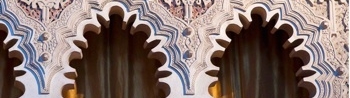
This newly conquered territory would be called in Arabic, al-Andalus, or Andalusia, and would survive for nearly 800 years. Under Muslim rule, the status of Jews was considerably improved, for Muslim law sees both Jews and Christians as ‘People of the Book,’ fellow monotheists whose rights are to be respected. And though there were occasional instances of religious discrimination, most Muslim rulers in Andalusia tended to look upon Jews pragmatically, as potentially valuable contributors to the economy, as well as helpful administrators in the government. This acceptance was enough to create a new atmosphere of hope and creativity among the Jews of Andalusia and quickly led to the flowering of Sefardi Jewish culture. Indeed, it is worth remembering today—when so much of the political dialogue around Islam has become polarized and fallen into caricature—that the first ‘Golden Age’ of Spain, as well as the ideal of Sefarad and La Convivencia, the fruitful co-existence of the three Abrahamic faiths, all took place under a Muslim flag.  

Although this ‘golden’ depiction of Andalusia is often idealized, it is not merely a nostalgic sigh over a mythical ‘Camelot’ in the early history of Islam; it is also reflected in contemporary accounts from the time, especially of those who traveled to its majestic capital. Córdoba, by the 10th-century, was a city without equal, filled with people of all nationalities. Visitors who walked its paved and illuminated streets were awed by its architecture and gardens, and overwhelmed by its amenities; for the city boasted of over 700 mosques, 300 public baths, and 70 libraries. The finer homes in Córdoba even had indoor plumbing. Nowhere else in Europe could one find such splendor and luxury.

An interesting legend from the time deals with both the ideals and the realities of this seeming paradise:

When God was preparing to create the world, Andalusia came as a supplicant and made five requests: clear skies, a sea full of fish, trees filled with every kind of fruit, beautiful women, and a just government. God agreed to each of the first four, but denied them the last request; for if Andalusia had justice as well, it would rival even Paradise! [3]

Nevertheless, there was enough justice to create opportunity for its Jewish inhabitants, and they took advantage of it. Those first ‘deputies’ of the Umayyad invaders set a precedent that would be followed and built-upon for generations to come. Indeed, Jewish courtiers and physicians would become fixtures in Muslim courts, sometimes achieving powerful positions as advisors and administrators. Occasionally, the power and influence of Jewish viziers or prime ministers in Muslim courts was such that some wondered who was actually ruling the kingdom, often arousing dangerous jealousies.

These were makers of Sefardi civilization. That is not to discount the contributions of Jewish rabbis, artisans and merchants, who were the life-blood of their communities, but to say that these courtiers and physicians had access to the citadels of power and privilege, and often used them to improve the situation of their fellow Jews. They also provided their brothers and sisters with an opportunity to participate in a Muslim culture that was reaching its zenith, allowing them to explore new discoveries in science and mathematics, new thinking in philosophy and theology, and new forms of poetry and music, all of which were used to enhance traditional Jewish knowledge and culture. In many ways, Sefarad was a pearl cultivated within the shell of Andalusia, a parallel Jewish civilization growing in the sun of an Islamic empire then at its height.

However, its accomplishments were its own, and there was hardly a field of endeavor in which Sefardim did not excel and make their mark. Indeed, many of the most celebrated personalities in Sefarad were distinguished in more than one in field. Most of them had become accomplished Jewish scholars in their youths, mastered several languages along the way, and had learned to compose poetry on almost every imaginable subject. Over the flesh and bone of this education, they wrapped themselves in the robes of rabbis, physicians, philosophers, astronomers and ministers of state, some of them becoming legends in their own time. It was a world in which religion and art, science and politics were all woven together in one exquisite tapestry.

But Sefarad was not self-sustaining. It was dependant on Andalusian sovereignty. Thus, even as Sefardi culture was reaching its peak, the Muslim star in Spain was about to fall. Indeed, some believe it had started a slow descent shortly after the armies of Umayyad Caliphate had entered the Iberian peninsula in 711.

In 722, the advance of the Muslim forces was stopped at the Battle of Covadonga by Pelayo of Asturias who established a Christian kingdom in the north of Spain. For Christians, this victory marked the symbolic beginning of the Reconquista, or ‘re-conquest’ of Spain for Christianity. By the year 801, the whole of the north had been reclaimed, and although the northwest was briefly retaken by Muslims, by 914 it was permanently occupied by Christians. However, it would take them more than 270 years to secure central Spain and to conquer its jewel, Toledo. But once this was accomplished, around 1250, only the small southern Muslim kingdom of Granada remained, all that was left of once proud Andalusia.

During this process of reclamation, the Jews of Sefarad were caught between the hammer and anvil. On the one hand, they weren’t sure they wanted to live under Christian rule; but, on the other, life under the Muslims was becoming increasingly difficult. As the Muslim rulers were driven back year after year, the Muslim populace began to cling all the more fiercely to their identity as Muslims, and unfortunately, became less tolerant of the Jews in their territories.

In the 12th-century, there were numerous outbreaks of violence against Jews in Andalusia. And when the zealous and religiously intolerant Almohad Muslim forces swept into Iberia from North Africa to stem the Christian advance, things only got worse for the Jews. For the Almohads were not inclined to treat the Jews as a ‘protected people,’ as Muslim law dictated, but put severe sanctions on them and even forced conversions to Islam. So, once again, a religion wedded to political power had created crypto-Jews on Spanish soil.

Under these conditions, the Jews of Iberia had only three choices: to bear with these conditions until they eventually changed; to flee to other, more liberally ruled Muslim lands; or to cross the border into the Christian controlled north of Spain. For many, the latter option became increasingly attractive. The new Christian rulers needed to colonize these recently conquered territories, and in places like Toledo, Saragossa and Valencia, Jews were offered special inducements to settle—land grants, tax exemptions, and the promised protection of the king. As Christians pressed the war on the southern front, once again, Jews were assigned military responsibilities and left as a rear-guard, just as they had been by Muslim forces. They were also given the responsibility of developing the economies of these newly Christian territories, and in some cases, were even given charge over the finances of Catholic religious orders.

So, for a time, Sefarad continued under Christian rule, and the pearl that had matured in Muslim Andalusia was still considered valuable in Christian Spain. After all, Jewish courtiers had been intermediaries between Muslim and Christian kingdoms for centuries and were trusted by both sides precisely because they had no kingdom of their own to serve. Thus, they quickly resumed their traditional roles as courtiers and physicians, only now in Christian courts, and Jewish scholarship and achievement continued along the old lines, though a new flower of Sefardi civilization was emerging—kabbalah.

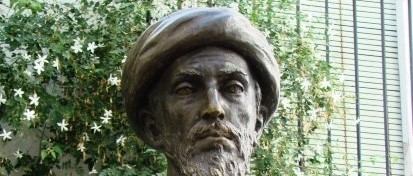
Kabbalah, or ‘that which is received,’ is the name given to the rich and varied tradition of Jewish mysticism that began to take shape all over Spain at this time. On reflection, it is interesting to note just how much the symbolism of this secret tradition seems to have been influenced by the sunlight and intricate patterns of Spain and its culture in this period. When discussing the origins of the kabbalistic tradition in Spain, some scholars have suggested that, as their world began to destabilize in the 12th-century, the Sefardim began to embrace a more impassioned spiritual outlook and rejected their former rationalism, exemplified by the brilliant philosophy of Moses Maimonides. But others are quick to point out just how influential the thought of Maimonides was on these early kabbalists, introducing them to more refined and sophisticated notions of God and spiritual practice. Whatever the case may have been, it is in 13th-century Spain, with its mix of extreme rationalism and religious fervor, that we first see the emergence of the Zohar, arguably the most important work of Jewish mystical thought, and numerous other classic texts of esoteric wisdom.

Nevertheless, it was becoming clear, even as this new jewel of Sefardi culture was forming, that the fortunes of Sefarad were in decline, having only outlasted those of Andalusia because they were more portable. In the 14th and 15th centuries, the old anti-Jewish legislation was reinstated in many major Spanish cities as anti-Jewish resentment became more and more prominent. This was followed by numerous anti-Jewish riots and forced conversions, creating a new incarnation of crypto-Judaism and yet another reason for despising the Jews. Soon, Spanish rulers were talking about the “Jewish problem” and how they might solve it. Eventually, it was decided—early in 1492—that the only lasting solution was their expulsion from Spain. Thus, the Jews of Sefarad were divided, part being exiled and fated to find new homes—in Morocco, Italy, Turkey and elsewhere—and another part exiled within Spain itself, their Jewish identities hidden under a guise of Christianity, ever hoping to be reunited with their brothers and sisters abroad.


Notes

[1] Josephus, The Antiquities of the Jews, 14:115.

[2] Council of Elvira, Canon 49, quoted in Jane S. Gerber, The Jews of Spain: A History of the Sefardic Experience, New York: The Free Press, 1992: 6.

[3] Ibid., 28.