The Dance of Shiva

Netanel Miles-Yépez

“The Dance of Shiva” by Netanel Miles-Yépez, 1999.

“The Dance of Shiva” by Netanel Miles-Yépez, 1999.

In the ancient forest of Tillai, there once dwelt a great community of shamans practicing austerities and making endless sacrifices to achieve magical powers which they worshiped in their ignorance. But when their pride in their abilities had reached its height, the Supreme Lord, Shiva, devised a plan to humble them and remove the veil of ignorance from their eyes.

Thus, Lord Shiva took the form of Bhikshātana, a naked and divinely beautiful ascetic, and asked his counterpart, Lord Vishnu, to accompany him in the form of Mohinī, a beautiful and similarly naked enchantress. Dressed in these exquisite bodies, they entered the shaman’s village separately, the naked Bhikshātana approaching the huts where the wives of the shamans congregated, and the naked Mohinī approaching the sacrificial fires of the shamans. 

When the wives of the shamans caught sight of the naked young ascetic, Bhikshātana, and heard the music of his divine drum, they were immediately pierced by the arrows of Kāma, and their passions were quickly enflamed. So powerful was their desire for him that they soon began to tear at their clothes, struggling to become free of them, until all were naked and moving spellbound toward the beautiful young ascetic. Some of them, not having any cooked rice to offer to the beggar, took uncooked grains in their hands and approached him, allowing the rice to swell in the moist heat of their passion. The younger women begged him, wildly, to become their lover; while the older women simply swayed and danced in the remembrance of past ecstasies. Meanwhile, near the sacrificial fires, the shamans were similarly enchanted by the divinely beautiful Mohinī; filled with an intense desire for her, they followed her blindly to the center of the forest, just as their wives followed Bhikshātana.

When the crowd of impassioned villagers began to arrive at the center of the forest, and the shamans finally saw their naked wives crowding around the young ascetic, they were dumfounded. But their astonishment did not last and soon gave way to an intense jealousy and anger. Realizing some powerful magic was at work, they took counsel together to kill the beautiful ascetic who, unbeknownst to them, was really Lord Shiva in disguise.

Quickly, they prepared a sacrificial fire, and with magic spells invoked what they hoped would be the means of Lord Shiva’s destruction. Soon, a tiger of prodigious size formed in the fire-pit and burst from the flames, racing ferociously at Lord Shiva. But it raced only to its death; for Shiva simply extended his arm to meet the beast and deftly peeled the skin from it with the sharp nail of his little finger. Then, as if nothing out of the ordinary had happened, he simply picked-up the tiger skin and lay it across his shoulders like a shawl.

Again, the shamans went back to the fire-pit, and this time called forth from its twisting and darting flames, a tangle of deadly serpents. But, as if intoxicated by the tremendous power of Lord Shiva, they merely climbed his limbs like the creeper, undulating on his body like living ornaments. And, as if response, Lord Shiva, like the snakes, slowly began to dance a dance of bliss. As he moved, his two undulating arms appeared like four, and on his forehead, a third eye seemed to glow, revealing the true identity of the beautiful ascetic in his full glory.

But blinded by fear and rage, and more than a little hubris, the shamans could not stop themselves. Concentrating all their rage and desperation, they caused the fire-pit to belch forth a creature of the most dense darkness, a demoniacal dwarf. The creature roared in its ignorance and rushed upon the dancing Lord with murderous intent, crushing the ground with each impossibly heavy step. But Lord Shiva did not even bother to break the rhythm of his beautiful dance. He simply raised his leg in one elegant movement and allowed it to come down on the dwarf with perfect timing, breaking the creature’s back with destructive precision, subduing him beneath his divine foot.

Now, Lord Shiva was truly ready to unfold the full majesty of the dance, to real himself as Nataraja, the Lord of the Dance, manifesting all the divine attributes, revealing the glory of the five-fold activity of the universe. In one hand, a drum appeared, making the primordial sound, the beat of time and rhythm. With another hand, the dancing Lord made the gesture of preservation, quieting all fears. In a third hand, Nataraja held the fire at the end of time, while the final hand and arm crossed the divine breast, concealing the sacred heart, just one finger of its hand pointing to the blessed foot. It was the foot of the left leg, which, in the course of the dance, was concealing the place of the genitals, paradoxically revealing the non-duality of the dancing Lord, who transcends all pairs of opposites.

Seeing this awesome sight, the shamans collapsed, their stubborn will to ignorance finally exhausted. Now, the sublime power of the dance enraptured all who witnessed it. The shamans were redeemed and enlightened by the unfolding of the mystery of the dance of bliss. They began to praise Nataraja, who appeared not to listen, dancing on until all the shamans and their wives began to dance too. Indeed, all the creatures of the world began to dance, and universal joy was found in the vibration of Supreme Lord’s steps.


The Lord of the Dance is the expression of the five divine activities: creation, preservation, destruction, concealing, and revealing. As Ananda Coomaraswamy points out in his classic essay, “The Dance of Shiva,” the essential significance of Shiva’s dancing image is threefold. First, it is the image of divinity’s rhythmic play, the source of all movement in the cosmos (itself represented by the aureole of flames around the image). Second, the purpose of the dance is to release the souls of humanity from the snare of cosmic illusion. Third, the place of the dance---Chidambaram---is one’s own heart, the very center of universe.
The Making of a Colorado Santera: Teresa May Duran

Netanel Miles-Yépez

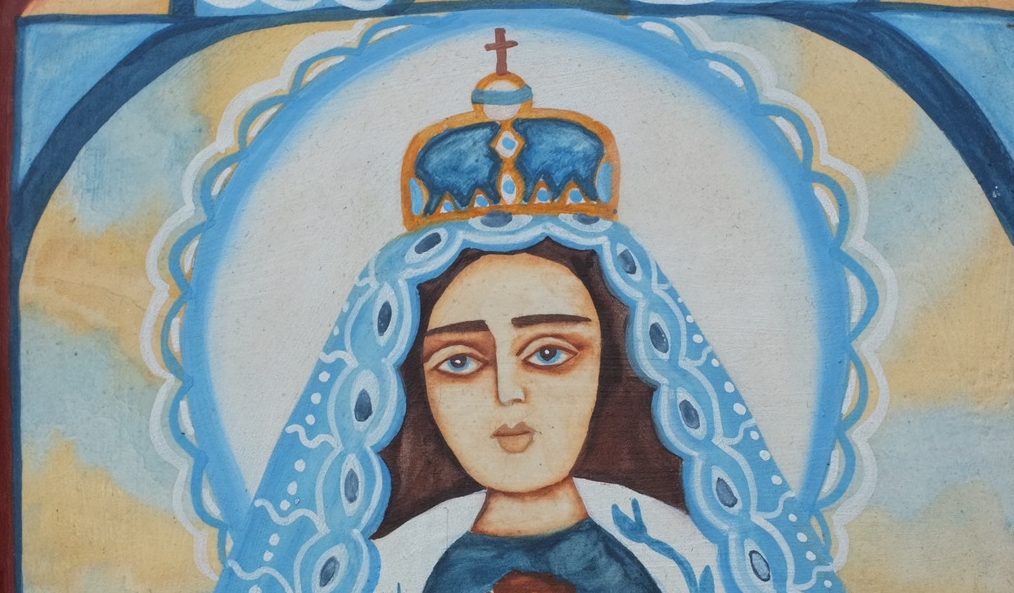
La Conquistadora in Colcha Dress. Photo by Amitai Malone, 2013

La Conquistadora in Colcha Dress. Photo by Amitai Malone, 2013

Teresa May Duran is a respected Colorado santera who, like many latter-day practitioners of the art, took up ‘saint-making’ only later in life while raising a family and pursuing another career. However, in her case, the seeds of what would become an obsession with this New Mexican and Coloradan art form seem to have been planted early.

Born in Pueblo, Colorado in 1955, her father, Henry Martinez King, was a barber and part-time rancher, while her mother, Eva Barela Maldonado, raised Teresa and her siblings at home. Both parents were from Huerfano County in Southern Colorado, her father being born and raised in Red Wing, and her mother in La Veta, in the foothills of the Spanish Peaks.

Teresa’s great-great grandfather, José Victorio Maldonado, who was born in Taos, homesteaded a thousand acres at the base of the Spanish Peaks in the 1870s, where he raised sheep and grazed cattle. This was considered a family tradition, as the Maldonados were originally shepherds from the Basque region of Spain.

Teresa’s mother, Eva, came from a large family of 14 children, and only attended school up to the third grade, as she was needed at home to help her mother with chores and to take care of the younger children. Among her chief duties were making the tortillas and bread for the family. Indeed, she was so identified with this task that her brothers and sisters called her the panadera, the ‘bread-maker.’ According to Duran, “She was the most wonderful cook, and very creative. She was a great inspiration in my life.”

Teresa’s paternal great-grandfather was James King, an Anglo homesteader who came up the Santa Fe Trail around 1870. His son, Charlie King, later married into a Hispanic ranching family in Huerfano County named Martinez, originally from the Taos area.

In 1965, when Teresa was about ten years old, her father Henry bought a small ranch in Chama, Colorado, to which the family would retreat on weekends. Shortly after he had purchased the land, he took Teresa with him as he went to look over the property. About 300 feet from the house was an old, two-room adobe structure with a cross out front and a padlock on the door. Breaking the padlock, her father entered the dark structure with Teresa trailing just behind. It was a morada, a meeting-house of the Penitente Brotherhood, a Hispanic fraternity of Catholic laymen who functioned as pious guardians for the communities of Southern Colorado and New Mexico.

Entering the starkly contrasting light and shadow of the morada, Teresa describes her experience that day and what she saw next:

"We walk in and we see the first room, which was like a storage room, where they kept the things they used in their ceremonies. That’s where all the noise-makers [matracas] and the flagellation whips [disciplinas] were kept. I remember they had a wooden candle-holder with candles all in a pyramid-like form. Both the wooden noise-makers and the candle-holder were huge!

"Then we walk into the chapel. The altar was still intact, and there were bultos at each side of the altar. I remember there were also chests filled with clothes that they used to change out the clothing of the statues for different ceremonies. And there were retablos along all the walls, along with Stations of the Cross.

"Now, my dad was a very tall man, about six foot, and he wore cowboy boots and a hat all the time. And here I was this little girl, you know, ten years old. Well, we walked into that room, on those old warped wood floors, and his cowboy boots and his being a big man caused the floor to shake; and all of a sudden, the hands on the saints started to move! ‘Cause, you know, the old bultos were not fully wood. The body of it is like a cloth doll, and they attached the carved hands and head to that so they could dress it like a doll. So when my dad’s weight shook the floors, the hands started to sway, and my father, right away, starts making the sign of the cross, and I’m looking around with my eyes wide, like, 'What’s going on in here!'”

Christ Crucified. Photo by Amitai Malone, 2013

Christ Crucified. Photo by Amitai Malone, 2013

After this experience, Teresa’s father would tease her, “Don’t go by the morada at night!” But it was too late; she was magnetically drawn to the building and its objects. For the next three or four years, she would go and explore the morada on her own, looking at its retablos and bultos, picking up the big matracas and swinging them until they made their distinctive sound. But, after a time, her father began to worry over the burden of being the guardian of these sacred objects, no longer in use and soon to be extremely valuable. So, around 1969, he sought out one of the last penitentes left in the area, a man in his 80s named Vigil, and asked him if he would come and remove the belongings of the Penitente Brotherhood.

About six months after the artifacts had been removed, Teresa remembers how a little twister came down from the mountains and hit the morada, destroying the roof and throwing all the vigas (beams) off the top of the adobe structure. The twister landed right on the morada, and strangely enough, touched nothing else in the area. Teresa commented on how a neighbor, Abe Bravo, had a large pile of loose hay just fifty yards away from the structure that was completely undisturbed. Without the roof and the vigas, the old adobe building was quickly worn down by the elements until only the foundation remained.

As a child growing up in Pueblo, Teresa described herself as a mediocre and indifferent student who, nevertheless, always loved to draw and make things. “I used to get into trouble by drawing on things,” she remembers. “One time, I made all these little puppets out of my dad’s black electrical tape—He was really angry! Another time, while my mother was sewing, I took a pair of her scissors and pulled up the fabric of my dress into little peaks and cut the tops off to make patterns. By the time my mother looked at me, I had holes all over my dress! So I think I was fascinated with shapes and colors since I was really young.”

After graduating from Pueblo’s South High School in 1973, Teresa went to live with an aunt in Santa Ana, California for a year, where she worked in a factory, soldering diodes on computer boards. Unsatisfied with this work, she returned to Colorado to go to college.  In high school, she had been in a program called Upward Bound, which targeted students from low-income and minority families for special attention in order to prepare them for college. With the confidence she had gained in this program, she applied and was accepted to the University of Southern Colorado in Pueblo, where she studied social work. But, even then, she could not wholly abandon her love of art and enthusiastically took a class on the art of the Southwest. As a part of the class, the students took a special field trip to Santa Fe, New Mexico, to see the traditional retablos and bultos in the museums there.

When she had completed her Associate Degree in human service work, Teresa was undecided about her next steps. She began to take classes toward a Bachelor’s Degree, but wasn’t completely certain of her aim. So she went to live with her sister in Santa Fe for a time to consider her options. Not long after, while visiting her parents in Pueblo at the Christmas holiday, she ran into a young man she had once dated. His name was Ernest Duran Jr. and he was studying law at the University of Colorado at Boulder. Happy to have reunited, but doubtful about long-distance relationships, he asked her if she would come to Boulder. To his surprise, she said, “Yes,” and the two were married shortly after.

After finishing Law School, Ernest got an internship with the National Labor Relations Board in Houston, Texas, where the couple lived for a short time. He was then offered a job with the same in Denver, where he afterward had a long career in labor relations and the couple raised their three children—Ernest III, Crisanta and Caroll.

When her youngest child was about three years old, Teresa decided to finish he Bachelor’s Degree at Metropolitan State College of Denver. The stress of social work no longer seemed manageable while raising her children, so she pursued a new degree in business administration. She later got a job working for the City of Arvada in affordable housing, and after two years, went to work for the State of Colorado, developing affordable housing all over Colorado. Eventually, she worked her way up to Deputy Director. While filling-in as Interim Director over a six-month period in 2009, she was offered the position of Director. But, at that point, Teresa decided, “Time is short,” and retired so that she could dedicate herself to painting santos full-time.

Over the years, she had painted whenever she could find the time, mostly as a hobby. But sometime in the early 1990’s, Teresa bumped into an old friend from the University of Southern Colorado—Meggan Rodríguez DeAnza—while attending a Chicano art show at the Denver Art Museum. Although they had lost touch many years before, they recognized one another immediately. In the interim, Meggan had gotten her Master’s Degree in Art and had pursued a career as an art teacher in the Denver school system. As both shared a love of painting, the two began rekindle their friendship. At the time, Teresa was mostly painting watercolors and showed them to Meggan, who suggested that she might be good at painting retablos. She then showed her some that she had painted herself while living in Taos, New Mexico, and Teresa fell in love with them.

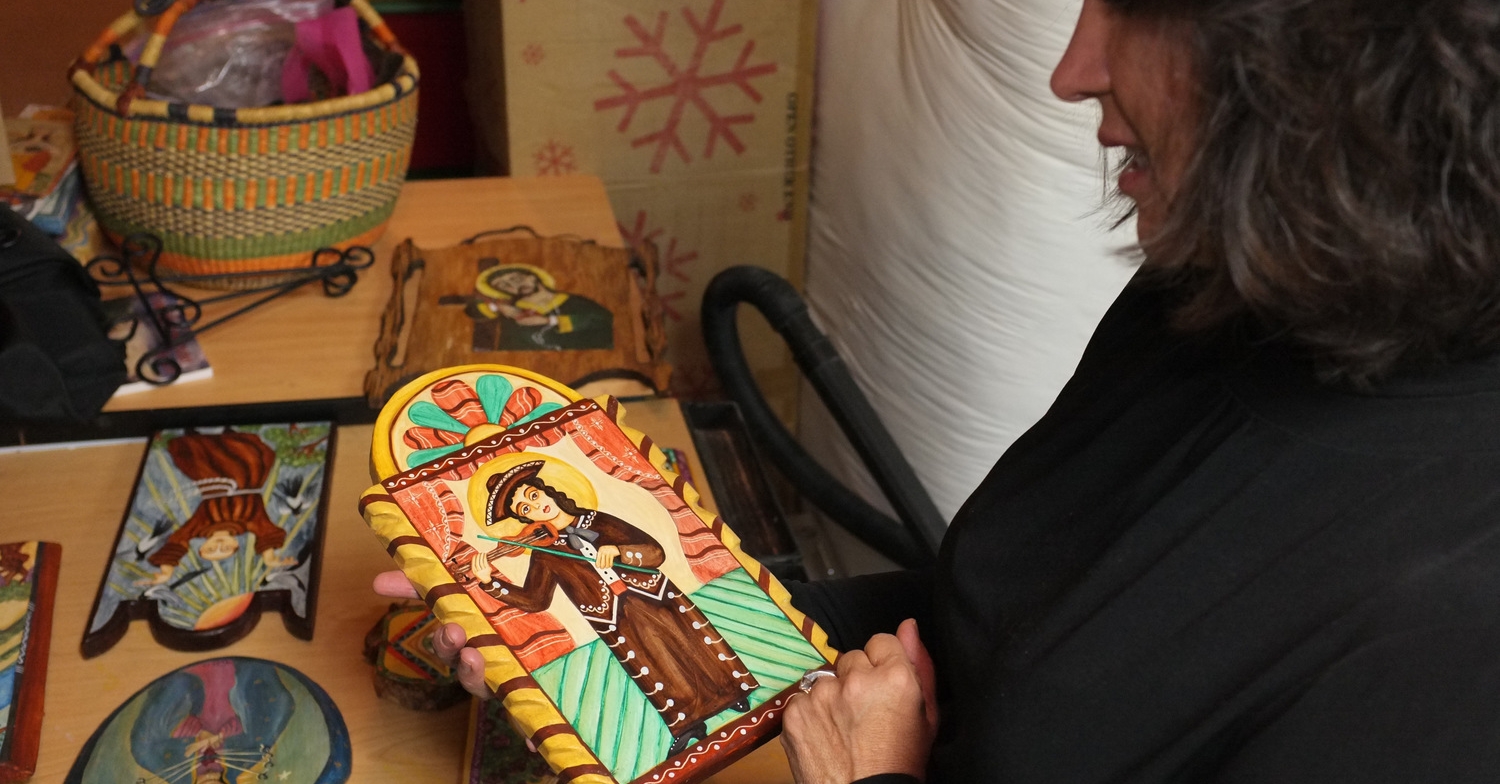
Teresa Duran holding a retablo. Photo by Amitai Malone, 2013

Teresa Duran holding a retablo. Photo by Amitai Malone, 2013

Encouraged and inspired by Meggan’s work, Teresa slowly started to imitate and produce her own renderings of traditional santos in acrylic paint on pre-cut wood from the store. Then, in the early 1990s, she participated in an art show at the Denver Botanical Gardens for the Chile Harvest Festival. There she met a retablo painter and college professor named Juan Martinez who told her that she could easily work with the traditional materials, using the traditional techniques. He said, “Teresa, this is what you do” and began to tell her how to make the gesso, giving her ‘round about’ measurements. Teresa remembers, “I wrote it down—and being the daughter of a fabulous cook that could throw everything together—he told me things, and I picked it up very quickly. I mean I just went to the stove and I did the animal skin glue like he told me, put the gesso together, and it just came out!” But she did not make the transition to natural pigments as quickly. She first began to paint in watercolor on the homemade gesso, and then tried a combination of watercolor and natural pigments before becoming comfortable enough to use the latter exclusively.

Once she found that she could actually do it all herself, Teresa became passionate about the traditions and the entire process of saint-making. She began to buy the available books on santos and the work of santeros, and to ask questions of whomever was willing to teach her a thing or two. In this way, she learned where should could obtain cochineal, how to cook-down chamisa, and how to use alum to make her colors more vibrant. She also started to study Christian symbolism and sacred art in her spare time, especially Byzantine and Spanish Colonial art (the influence of which are both still visible in her work). On vacations in the American Southwest and South America, she and her husband made a point of visiting places that had examples of Spanish Colonial art as it developed in these regions; and in each of them, Teresa found new inspiration which she brought into her painting. Indeed, her passion for her new craft and the use of natural materials even started to creep into her professional life. Working for the state, Teresa often had to travel around Colorado inspecting housing and meeting with other public officials. And often, in the course of a car ride through the mountains, colleagues would not be surprised to hear her cry out suddenly, “Stop the car! Look at that dirt! We gotta’ pick up some of that dirt!” Then they would watch in amusement as she got out of the car to collect a little red or black dirt in a cup or bag to take home and use as a pigment.

Through the years, Teresa’s painting has become more refined as she has achieved greater mastery over the medium. Nevertheless, her distinct style and bold presentation of evocative imagery has remained a constant from the beginning. Her work is distinguished from that of many others by her attention to symbolic detail and cultural context, by the incorporation of stylistic elements from both Spanish Colonial art of different regions and Byzantine iconography, and by her excellent color work. In each piece, there is a strong sense of story and the artist’s commitment to depicting an important spiritual or moral ideal.

Although she received early recognition as a santera—her work being used on the posters for the Denver Chile Harvest Festival in 1995 and the “Santos: Sacred Art of Colorado” exhibit at the O’Sullivan Arts Center of Regis University in 1997—Teresa found it difficult to find enough time for her passion until she finally retired in 2009. By then, she had already been a santera for 18 years and had participated in many shows and festivals in Colorado and New Mexico. Nevertheless, she had never applied to the famous Spanish Market in Santa Fe, New Mexico. It was something she felt she simply could not manage while working for the state. But as soon as she retired, she set to work on the difficult application process for the 2010 Market, and to her great surprise, was accepted on her first attempt. Since that time, Teresa has participated in both the Summer and Winter Spanish Markets every year, and continues to participate in exhibits and shows throughout Colorado and the greater Southwest, including the annual Rendezvous & Spanish Colonial Market of the Tesoro Cultural Center in Morrison, Colorado.

Today, Teresa and her husband divide their time between their home in Arvada, Colorado, and their ranch in Las Animas County, from which they can view the Spanish Peaks. When they are not traveling to a show, they like to visit different countries where Teresa can find new inspiration. Most recently, they visited Israel to soak up influences from the land of the Bible and the birthplace of Christianity.

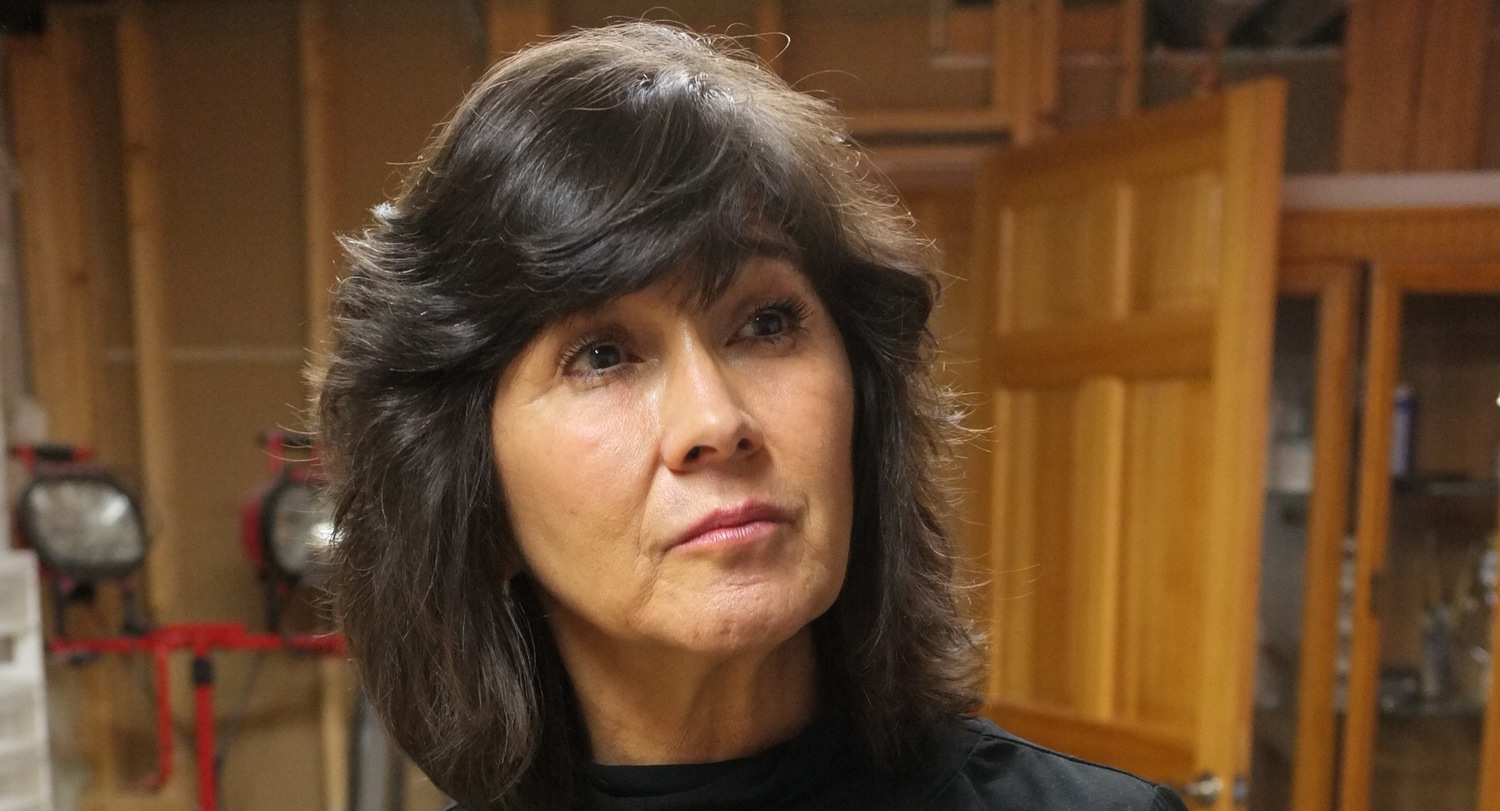
Teresa May Duran. Photo by Amitai Malone, 2013

Teresa May Duran. Photo by Amitai Malone, 2013

Spiritual and Religious

By Netanel Miles-Yépez

Without a doubt, it is a new day for spirituality. In the popularity contest of modern life, it is religion which can’t get a date for the prom. More and more, people are declaring themselves “spiritual but not religious,” which is both progress and a problem for us.

The problem with being “spiritual but not religious” is that it is a dead-end for the spiritual seeker. Without the positive ‘tools of religion,’ it can only describe a person’s point-of-view: on the one hand, a sense of wonder and personal conviction about transcendent possibilities and the numinous; on the other, a disinterest in, or dissatisfaction with known religious history, structures, and dogmas.

Don’t get me wrong; I’m not criticizing people who identify themselves as “spiritual but not religious.” Anybody who feels compelled to choose spirituality over religion has, in my opinion, “chosen the better part”—to quote Jesus from the Gospels.[1] Sometimes it seems like the only appropriate response to the religious confusion of our time. The problem arises when we are asked, or ask ourselves, “How are you ‘spiritual but not religious’?” For when we try to answer the question, we either have a difficult time explaining it, or immediately start to name activities or refer to teachings from existing religious traditions that undermine the original statement.

This is because it is actually a mistake to separate religion and spirituality, as if the two were opposed to one another. The truth is that they are natural partners and cannot be separated without doing damage to the greater goal. Religion in this partnership is what you do or use to accomplish spiritual transformation. It is not something in which you must believe. It is a tool that performs a service for us, something we utilize for our own spiritual development. Unfortunately, we often find ourselves being used by the 'tool' in the end; but that’s not the fault of religion.

It is up to us to gain an understanding of what it is with which we are dealing, to know what our own position is relative to our religious traditions. Obviously, if we make an idol out of religion, we become its servant and can expect to be used. But if religion is the tool that we use to gain access to the sacred, then we are in the right relative position to achieve our own ends with it.

For as long as we can remember, we have been in relationship with this thing called ‘religion.’ So long in fact that we sometimes forget who created whom. We treat it like an ‘All-knowing God’ over our lives, slavishly trying to live up to its apparently divine dictates. The irony is, we created it to help us remember how to connect with the sacred, to help us achieve an experience of the ultimate reality. Even the word tells us as much; for ‘religion’ derives from the Latin re-ligare, meaning ‘to link back’ or ‘re-connect.’ It is what links us to the source or essence of our being, to all that we would remember about how to connect with that source or essence.

When discussing his theory of spiritual renewal, the ever-innovative Zalman Schachter-Shalomi would sometimes borrow the Latin word, magisterium, from Catholicism to describe a religion’s collected body of knowledge or wisdom.[2] But it is also a good way to think about religion in general, i.e., as a body of spiritual teachings and lore, rituals and techniques, carried down and growing ever-bigger through the centuries, like a slow-moving glacier carried onward by its own gravity. That is to say, religion is our collective memory of spiritual technologies and instruction manuals, the means by which we can ‘re-connect’ with the sacred dimension—but which is not itself sacred.

What is sacred is spirit or spirituality. Spirit is the living essence of the sacred, the divine life, as it were. Spiritus, as the Latin suggests, is the divine ‘breath’ in the body of the human being, the planet, and the universe. It is the ‘active ingredient’ in all things, including religion. If we were to concretize it into a working definition based on human experience, it might be characterized thus:

Spirituality is an awareness of a transcendent value encompassing, permeating, or hiding just below the surface of material existence; it is the living essence of the sacred at the center of one’s life.

Nevertheless, spirit is impotent without a body to carry its essential message. And this is the rub for the “spiritual but not religious.” While religion without spirituality is, as so many have come to realize, just a dead body without a soul; at the same time, spirituality without religion is a soul without a body. It can’t do anything in the world. Thus, one’s spirituality is limited to a vague sense of something ‘other,’ something ‘beyond,’ which may bring us hope, but little help. Without the structures of teaching and practice, i.e., religion, we cannot accomplish the spiritual transformation of our lives for which so many of us long.

Nevertheless, the idea of being “spiritual but not religious” is a critical insight for us today. What we are really saying is that we have a sense that the two—spirituality and religion—have become divorced, that the life-spirit has left the body of religion, making it dead for us. When people began to quote Nietzsche in the late 1960s, saying, “God is dead,” what many actually meant was that religion was dead for them.[3] But even if we acknowledge the ‘death of religion,’ we are still left with the problem of the soul without a body. This is where so many of us find ourselves today, longing for spirituality, but lacking the means of deepening our relationship with it.

Although spirituality is indeed “the better part,” it is limited in what it can do for us unless we learn to pair it with a proper understanding of religion.

(Part two of a three-part series on The Religion of Spirituality.)

Notes

[1] The New Testament, The Gospel of Luke 10:42.

[2] Zalman Schachter-Shalomi and Netanel Miles-Yépez, God Hidden, Whereabouts Unknown: An Essay on the ‘Contraction’ of God in Different Jewish Paradigms, Boulder, CO: Albion-Andalus Books, 2013: 7.

[3] Friedrich Nietzsche, The Gay Science, tr. Walter Kaufmann, New York: Vintage, 1974: 181.


The End of Religion

Netanel Miles-Yépez

RW-Tower.png

Religion as we have known it is breaking down. The evidence is everywhere we look. It is in the despicable rhetoric and violence of politically oriented religious extremists, far and near. It is in the scandals and abuses plaguing our current ecclesiastical structures. It is in the surface tension between the ‘religious right’ and modern culture, in the growing indifference of that culture to religion, and its occasional disgust with it. And yet, it is not religion itself that is so evidently coming apart in all of these examples, but an old and outworn idea of religion as an-end-in-itself, as an idol that has—for far too long—been mistaken for its maker and its goal. It is that idol which is now being broken. Religion will go on; it is how we relate to it that will change, and must change, if we are to reclaim its genuine usefulness to us.

Over a century ago, the Russian philosopher, P. D. Ouspensky explored the symbolism of “The Tower” in the Tarot deck as an important metaphor for religion. The tower, he said, was begun in a time before memory, as a monument to the sacred, a reminder of the true tower in each of us, its every level representing a level to be climbed on the inside. But even before the foundations were fully laid, some of the builders began to “believe in the tower of stone they had built,” and to teach others to believe in the same. To them, the tower was itself sacred, and they soon tried to control access to all its doors and windows, and to occupy the summit and the very ‘rights to heaven,’ as they saw it. They even began to fight over these rights in their confusion. Thus, of all the people of the earth, the worshipers of the tower were the most surprised when heaven spoke from beyond its walls in the form of a lightning bolt, sending its priests sprawling to the ground, where they lay helpless amid the rubble. Now, says Ouspensky, all who look on its ruin and see its broken summit—open to heaven as it always should have been—know not to believe in the tower.[1]

As the metaphor suggests, the real issue is one of remembering the original function of the tower, of maintaining one’s awareness of the true meaning and purpose of religion, i.e., that it is a reminder of the sacred. The problem is, it is just so easy for us to forget that religion is not sacred, but merely a vessel for the sacred. Although, truth be told, I wonder how many people ever made the distinction in the first place. I don’t think I would be going out on a limb to say that religion is not well understood in our culture. Often, it is assumed to be ‘right and necessary’ by the religious, or ‘backward and unnecessary’ by the secular; but how many people really know anything about it in itself, about its function, or how it works? How many people, religious or secular, can actually give a working definition of religion? Perhaps if we really knew something about the true end of religion, we might better understand why religion as we have known it is currently breaking down, and more importantly, get a glimpse of what is currently evolving—namely, ‘the religion of spirituality.’

But let me back up a step and propose a working definition of religion:

Religion is a sociological construct meant to take us back to the primary experience from which it arose; it enshrines an ideal and provides one with a structured approach to spiritual awakening or transformation.

That is to say, religion is what follows in the wake of the spiritual luminary’s breakthrough experience; it is what happens after Muhammad receives his revelation, or the Buddha his awakening; it is what their disciples cobble together from reports of those experiences, using them to make a ‘map’ to lead themselves and others back to the source experience. As the Buddha himself taught: religion is like a raft one makes and uses to cross a river; once you are on the other side, you needn’t carry it around on your back.[2] It is just a means to an end, not the end itself.

We must always remember then that the map is not the sacred territory; it must be used by us (with its original purpose in mind) and not the other way around. As my teacher, Zalman Schachter-Shalomi, once put it (while commenting on the abuses of various religious extremists), “Good religion puts itself in the service of God; bad religion puts God in the service of religion.”[3] It is the latter that usually has us so upset with religion, that causes us to question its foundations, and which is the cause of all that seems to be breaking down in religion. But this is religion misused and misconstrued. It is a false religion that puts the sacred in its own service. False religion is to true religion what the cancerous cell is to the healthy cell. It is this imposter that provokes our most vehement objections, and which now has us looking up at a broken tower and boldly declaring, “A new day for spirituality!” as we wave goodbye to the “old-time religion.”

(Part one of a three-part series on The Religion of Spirituality.)


Latlaus Sky

Notes

[1] P. D. Ouspensky, The Symbolism of the Tarot: Philosophy of Occultism in Pictures and Numbers, tr. A. L. Pogossky, New York: Dover Publications, 1976: 48-49.

[2] “The Raft Simile” in the Pali Alagaddupama Sutta.

[3] Heard directly from Schachter-Shalomi after he gave a Yom Kippur sermon at Makom Ohr Shalom in Los Angeles, California, in which he used this formulation for the first time, ca. 2009.