Accessible Subtlety: A Review of the Path of Centering Prayer by David Frenette

By Netanel Miles-Yépez

"The Cloud of Unknowing" by Netanel Miles-Yepez

"The Cloud of Unknowing" by Netanel Miles-Yepez

For almost 40 years now, that great Trappist triumvirate from St. Joseph’s Abbey in Spenser, Massachusetts—Father Thomas Keating, the late Father Basil Pennington, and Father William Meninger—have been teaching the practice of Centering Prayer (which Meninger, the one-time retreat master there, revived from indications in the anonymous mystical classic, The Cloud of Unknowing). At first, it was taught only to their brethren in the monastery and to retreatants who wished to practice a Christian form of meditation; but, by the mid-1980s, the three ‘fathers’ were taking it out of the monastery and teaching it to the larger community of Catholic and Protestant Christians around the world.

Brilliant teachers all, they have each written popular books, looking at Centering Prayer from different angles, creating the verba seniorum, the ‘sayings of the fathers,’ of Centering Prayer. But what will happen when these men, ordained by the Church, with their aura of monastic authority, are all gone? Will there be enough stability and strength among the lay leaders of the Centering Prayer movement to hold the lineage of practice together? These are questions I have asked myself in recent years. For it seemed to me, that until the ‘children,’ the leaders of the next generation, began to create their own body of teaching and commentary on the practice, the establishment of a long-term tradition and lineage of Centering Prayer was in doubt.

Thus, I was delighted to hear that David Frenette (one of Father Thomas Keating’s most senior students and an important teacher for Contemplative Outreach), whom I have known in a casual way for a number of years, had finally come out with The Path of Centering Prayer: Deepening Your Experience of God (Sounds True, 2012). I have long had a sense that Frenette was somehow carrying the practice of Centering Prayer out of the monastic context in a very authentic way, in a way that manages to preserve the more important structures of the contemplative life. But it wasn’t until I had read his book that I knew this for sure. In The Path of Centering Prayer, Frenette’s mature understanding of the practice and humble authenticity come across on every page, and in the end, he accomplishes what none of his predecessors has been able to do, convincingly—give believable expression to the contemplative life as it is lived in the world outside of the monastery.

The sixteen chapters of the book are divided into two parts, the first giving increasingly subtle and nuanced instruction in Centering Prayer, and the second discussing different “contemplative attitudes.” The two parts of the book are meant to compliment one another, so that if the reader becomes “overburdened by instructions,” he or she may flip to Part II and dip into its more expansive reflections. But, in my opinion, it is the subtlety of instruction in Part I that really sets the book apart. For, although it is still accessible enough to be used by beginners in Centering Prayer, its insights clearly reflect the extremely subtle understanding of an experienced meditator who also wishes to guide his students through the deeper levels of awareness only accessible through the practice. Frenette gives the reader instruction he or she can ‘grow into’ over many years of practice, returning to the book whenever necessary for new understanding. Thus, The Path of Centering Prayer is also a ‘second level’ manual of spiritual practice (a rarity in today’s market which seems almost entirely comprised of ‘beginner books’). But it is precisely the book’s multi-leveled accessibility to beginners and experienced practitioners alike, to professional religious and laity, that will help to ground and sustain Centering Prayer as a tradition of living practice for many years to come.

The Ripening of Repentance

Keith T. Phillips

Truly Your faithfulness is better than life;

My lips declare Your praise.

I bless You all my life; 

I lift up my hands, invoking Your name.

— Psalms 63:4-5


The psalm appointed is truly a song from a joyful, thankful soul; one that is in near union with its God. Wonderfully does the Psalm express liberation from troubles, suffering, sin—while keeping in mind whence it has come; from the horror of sin to redemption. The psalm may well be one of delight after years of prayer, for the soul undergoes much purgation throughout those years in prayer. It expresses the resounding gratitude and surrender of repentance. It is the gift from a soul God deems a friend for its redemption. The soul of Moses.

We know the classical steps in repentance:

In remorse, we live a deep and sincere regret for one's act. An unequivocal expression, quite naked, of the acute knowledge of the pain and suffering one has caused; an expression that is forgetful of self.

In confession we give an unfettered admission of one's actions in the offense; an admission which does not seek to blame—or excuse or minimize. Neither does it attempt to recast one's self-image. It is a clear statement of responsibility.

In turning away from and forsaking those sins, the soul now enters the more refined, difficult stage. This turning away and forsaking requires both self-knowledge—which is often painful to encounter and accept—and determination to reform.

To see oneself as one is seen and known, and not step back from that harsh reality is essential now. We often falter because we find how dependent we have become on the 'old self'; how central to our false self is the structure which enabled the sin. A great deal of trust (perhaps new to us), in abiding this solitary pain, has to be endured in this darkness. Slowly, we learn the dimension of faith and hope leading to renewal. There is a seeming endless grinding of time before we ‘discover’ we have been, all along, held and fed by the love of God. We understand, now, how blinded we were in our sin, how much we needed to embrace repentance.

Then we heartily pledge never to sin again. This pledge becomes a sort of living thing, for in order for repentance to be 'complete' we (joyfully) expend all our strength to living our resolve, in prolonged deep thought of and an abiding in the good God has given and continues to give, and a belief that repentance brings healing to our character (thinking, belief, attitude) and is a means of remedying our evil deeds.

We are not told anything about this process in Moses. It is clearly implied, for only in thorough repentance is he now open to the encounter with the burning bush (Exodus 3:1-15). Moses could not proclaim this song were it not so . . .

Perhaps we have lived, experienced a wretchedness like Moses' after he flees to Midian. We know it encompasses a long period of time—the self-blame, recrimination stalls repentance; refuses to receive God's love. Moses survives. He struggles, though, to leave aside his lingering hubris.His prayer can only be: "The sacrifice of God is a troubled spirit; a broken and contrite heart, 0 God, you will not despise" (Ps. 51). In waiting for God, he lives with his inner chaos.

In the chasm separating the murder and the burning bush, we see the profound reach and effects of sin . . . and the labor of repentance.

In his book, Wanderings, Chaim Potok offers a powerful and insightful reflection on Moses: 

"In a single moment of uncontrollable rage, he not only took a life—and no matter how cruel that Egyptian might have been, the prince Moses could have had no justification in slaying him—but he also threw away his entire future with the royal household." (I would also add he was further alienated from his own people.) "Further," Potok writes, "not once during his stay among the Midianites does he engage in combat, join the men in skirmishing with other tribes, do anything [emphasis added] that reminds us of his prior military training, his ability to kill . . . all he appears to do . . . is wander the wilderness tending the flock . . . it is women and children who regularly see to the flocks; the men are warriors."

Moses flees into the desert in self-exile. Without standing or family or clan, this is surely a death sentence equal to Pharoah's decree. From the well—representing the deep symbolism of water—he is invited to break bread in the priest Jethro's tent. We do not know the content of the exchange that would have taken place, but Moses remains.Seemingly, Jethro asks nothing of Moses. Did Jethro perceive Moses' anguish, his suffering? What did he read in the inward gaze, the faraway look in his guest's eyes? How did he perceive the woodenness of affect and deportment? Moses could offer this clan little or nothing, yet he comes under Jethro's protection, becomes his son-in-law . . .

Rabbi Potok continues: ". . . then the horror of the murder deepens into an endless nightmare of the soul. The killing was senseless . . . a man whose mind is clouded with a miasma of such nightmarish misgiving, cannot be a warrior, cannot kill [again] [emphasis added]. He can only tend flocks . . ."

To be rendered so useless, so ineffective, so full of self-reproach is a harrowing, seemingly unending existence. Even the ability to speak, to have a voice, disappears.

Rabbi Potok again: ". . . a man will perform a sudden unthinking act of heroism or horror, and then spend much of his life in an effort to penetrate into himself and search out the hidden source of his deed.Often there is no source other than the irrationality that is the underground ocean which our species floats [an appeal to abuse or history or provocation is essentially empty, a delay, for they merely fend off—ineffectually—the reality of inquiry]" . . . on occasion he will discover feelings and ideas buried deep within himself, frightening ideas, for they are at odds with everything he has been taught to hold dear [emphasis added]—and yet somehow they seem to him burning and blinding with truth—and he will try to see the shape of them, but they may yet be without form though he senses their power and is alternately attracted and repelled by their luminescence. Then he will haul them out of himself and stare at them in fear and astonishment—as does Moses now in the wilderness." At this point, Jesus' Parable of the Fig Tree (Matt. 21:18-22; Mark 11:12-25) is seen with power: at the moment the fig tree is about to be discarded as useless,unproductive, the Gardener begins His work, the work that is the core of repentance.

Other ideas, too, can be seen—the ones of redemption. Of equal power, awe, wonder. In the chaos, then, there are the seeds of order,creation. When, from the depths of our repentance we cry out, "My God,my God, where are You?" God answers, cultivating our repentance to produce a human being of worth; a human being able to love—and receive love-again. God's unceasing act of creation from all eternity enters once again the temporal.

Repentance is multi-layered, it calls for deep introspection and longing, a cooperative endeavor with God. It is a gift from God; under the tender care of the Gardener it yields proper fruit. And we can sing our Psalm from our heart and soul . . .

Saracen Chivalry by Pir Zia Inayat-Khan

By Netanel Miles-Yépez

pirzia2010.jpg

When I was in my late teens and first learned the tale of Parzival, as told by the venerable Wolfram von Eshenbach, and witnessed in my mind’s eye the initial encounter between this  famous Arthurian knight and his brother, the Saracen knight, Feirefiz, I was fascinated with the idea of such a meeting. I wondered: What code of chivalry must this Saracen know? How is a Muslim knight instructed in the ways of honor? Then, not long ago, I learned that Pir Zia Inayat-Khan, the son of Pir Vilayat Inayat-Khan and head of the Sufi Order, had just published a new book called Saracen Chivalry, and my mind immediately flashed back to that early image of Feirefiz, who accompanies Parzival to the Grail Castle, and I wondered: Was he perhaps a Sufi? To my astonishment, I soon learned that this was precisely the question Pir Zia had answered, giving us the book of counsels on chivalry originally given to the Saracen knight Feirefiz by his mother before he embarked on his journey!

But perhaps a little background is necessary. In the Parzival story, a Christian knight, Gahmuret, goes in search of adventure in the Holy Land and eventually enters the service of the caliph of Baghdad. Later, he wins the love of the “Black Queen of Zazamanc,” Belacane, and marries her. But the desire for adventure is still upon him and he eventually leaves her and returns home, where he marries another woman, Herzeloyde, and has a son named Parzival. Meanwhile, back in Zazamanc, he has also left Queen Belacane with a son, Feirefiz, who will one day go in search of his father.

This is what we know from the Parzival tale of Wolfram von Eshenbach. But Pir Zia tells us that, without his father to raise him, and knowing that Feirefiz would one day want to go in search of his father, Queen Belacane is left to instruct her son in the ways of chivalry, in the knowledge he would need to meet the adventure of life and not be found wanting. Thus, Saracen Chivalry: Counsels on Valor, Generosity and the Mystical Quest, is her testament to her son, the knight Feirefiz, to guide him on his journey through life.

It is a timely book. For today, as much as any other spiritual teaching, we need to talk about chivalry, about a sacred code of honor which can help to orient us through life. Having lost so many certainties, having witnessed the breakdown of so many culturally-determined values, we need to find new values of global import, universal principles that can help us create a new order of Saheba-e-Safa, ‘knights of purity,’ as spoken of by Pir Zia’s grandfather, Hazrat Inayat Khan, who first brought Sufism to the West. Thus I have asked Pir Zia to share a few excerpts of his book, Saracen Chivalry, with us here:

“On Pilgrimage”

To reach Mecca from Zazamanc a pilgrim must cross the Red Sea. She will reach her destination if her ship stays above water. The inner pilgrimage is different. To attain the House of the Merciful you must suffer the calamity of shipwreck. Your boat, your worldly self, must be capsized, broken to splinters, and sucked into the whirlpool. You must drink the ocean down to its briny dregs. You must plunge into the abyss and wash up gasping on the other side.

The other side is the Holy House that every pilgrim seeks, be she Sabian, Jew, Christian, or Moslem. Here all are gathered, and all stand equal before the Lord. Outer distinctions are abolished; the throng is draped in white. Everywhere is heard the cry, “At your service!”

In the House of the Merciful, time slows to a standstill. Past and future are nothing; the present is all. Space rolls up like a scroll. Everything that was, is, and ever shall be—every star and tree and cloud and idea—confesses the evanescence of its form. So confessing, with shattering delicacy it unveils the eternity of its essence. From the first to the last of the centillion and one things, that essence is pure being, the boundless shining forth of the One.


“On the Greater Struggle”

When Adam and Hawwa dwelled in the garden, God the Most High was always before their eyes. Yet they were not dazzled; their hearts were not pierced. Strangers to darkness, they could not know the meaning of light. And so the Creator ordained exile, condemning them to the desolation of banishment that they might one day taste the elation of homecoming. What is to come is better for you than what has gone before. From oneness they fell into manyness, from union into separation. They lost the garden of being and found themselves in the jungle of becoming. 

Knowledge of the world is the fruit that led man into the jungle and love of God is the fruit that ushers him back into the garden. It was Iblis’ duty to proffer the fruit of knowledge and it is the Messenger’s task to extend the fruit of love. Love’s fruit is like no other. At first it is sweet, then bitter, and finally bittersweet. It is poisonous, but also good medicine. The one who eats of it will suffer the agonies of death, but in time she will rise again more living than before. She will die to herself and rise again in the Real.

Eat the fruit of God’s love, my son, and return to his garden. Breathe the weather of the season of the rose. The names of the Most High are seeds. When they quicken in your inner ground, watered by worship and sunned by faith, the garden will spring to life in you. Like a bud, your heart will open, petal by petal, giving forth a ruby light and a heady attar. In your right breast you will then feel a flutter, and—lo!—another blossom, a white flower, more diaphanous than the last, a gossamer bloom of spectral beauty. When you inhale its delicate scent you will know it to be the essence of purity. To the commanding and blaming selves it is a somnolent drug. Let the antagonists sleep, and the tranquil self will awaken. A bud will now open in the middle of your chest. Its light is gold and green. As its petals tear apart, your primal nature will show itself. Summer will arrive in the garden. In your forehead and crown, in your belly and tailbone, in the palms of your hands and the soles of your feet, blossoms will unfurl. Your flesh will become fertile soil, your veins limpid streams. Butterflies will glide on the breeze of your breath. 

When all is in bloom, all a riot of color and fragrance, from the tongue of every flower will come these words, and you will know that you have come home:

O you tranquil self,

Return to your Lord, well-pleased and well-pleasing!

Enter then among my votaries,

Enter then my garden!


“On Justice”

Ambition knows no restraint. It seizes every advantage, caring nothing for honor and less for the protestations of the downfallen on whose backs it blithely treads. The law of self-interest, ruthlessly applied, can speed an egoist an untold distance on the path of power and privilege. Meanwhile the chivalrous youth lags distantly behind, murmuring at each bottleneck in the lane, “After you...”  

But the wicked will not always flourish, nor will the good always languish. As ‘Isa, peace be upon him, has foretold, “The first shall be last and the last first.”

If in this world vice gains glory and virtue earns nothing but hardship, in the next world the tables will be turned. The mightiest tyrant will discover himself a lowly suppliant of God’s forgiveness, while the poorest of his subjects—those, leastways, that were true to the truth—will be laurelled with the fragrant benedictions of paradise.

My son, keep the Day of Judgment always before your mind’s eye. On that day, everything will be made clear and nothing will remain hidden. There will be no room for pretense on the day their tongues and hands and feet bear witness to what they had done. 

Therefore, be patient. Strive continuously for justice, but know that the justice that earth cannot supply, heaven will provide. When someone offends against you, do not take offense. If he has acted unjustly it is he who will be called to account in the Sequel, not you. The injustice he has done is to his own self. So long as you guard your innocence you cannot be harmed. Yes, your worldly affairs may be impeded. You may even be injured bodily—even to the point of death. But if you have kept God’s pleasure, you will have lost nothing that cannot be honorably lost.

The wise Diyujanis* was once informed that a man had sworn to kill him. His only comment was, “It will do him more harm than it will me.”

Do not brood over the wrongs that have been done to you, nor seek the cold solace of revenge. Pray, instead, for the souls who wrong themselves by wronging you. They stand in need of your prayers.


*AKA Diogenes 


The Hanukkah Miracle of Re-Dedication

By Matisyahu and Netanel Miles-Yépez

So many of our friends are picking up the pieces of their lives this Hanukkah . . . in New York and New Jersey in the wake of Hurricane Sandy, and in southern Israel after the missile attacks there. And it reminds us that the troubles and conflicts found in the Hanukkah story are not just a thing of the past; they’re not ‘history’ for us, but a reality to which we can actually relate. Just as there were wars and troubles in that time, there are wars and troubles today—natural disasters and personal catastrophes that make a mess of our lives. But this is not the message of Hanukkah; that bad things happened to us then and continue to happen to us now. The message of Hanukkah is that miracles occurred at that time and also occur in our lives today.

What was the real miracle of Hanukkah? Some people say it was that a little band of Jewish rebels managed to defeat a numerically superior army of Greeks, an army who had taken over their land, and who had desecrated their Holy Temple. Others say it was the miracle of the oil; that the last little cruse of ritually prepared oil, somehow, lasted for the entire eight days it would take to make new oil for the Temple menorah. But maybe, just maybe, the real miracle was the miracle of re-dedication, of starting over and starting again.

The Hebrew word hanuk, means ‘to dedicate.’ And when we use the word, hanukkah, we are really talking about the ‘re-dedication’ of the Temple after it had been desecrated, and about the ‘re-dedicating’ of our lives to a relationship with the Source of All. So when our forbears decided to call the holiday Hanukkah, it is clear that they wanted to emphasize the aspect of it that has to do with starting again. But what is so miraculous about starting again and re-dedicating ourselves to something? The answer is: it represents something indestructible in us, something that hopes against hope, that gets up when all the evidence says that we’ll probably just get knocked down again later! To live inspired by hope is a true miracle in our world.

Sometimes this message about ‘re-dedication’ gets lost amid all the other themes of Hanukkah, amid all the dreidel-spinning parties filled with latkes and doughnuts. But if we really think about it, it makes Hanukkah one of the most personal of the Jewish holidays. After all, who hasn’t had to pick up the pieces of their lives? It doesn’t take a hurricane or a missile to make a mess of them. Often, we do a pretty good job of it ourselves. And when we are sitting there, amid all the rubble and ruin of it, we have to make a decision: will we get up and start again, or will we just lie down? All the miracles of the Hanukkah story start when Judah Maccabee and his followers decided to get up and fight back, when they decided to re-take the Temple and clean it up, and when they made the decision to re-light the Temple menorah with the oil they had, instead of waiting until they could make more. 

PICT0110.jpg

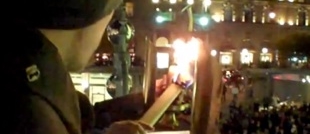
All it takes is a little light, a little hope to get started. Every year, Hanukkah comes around the winter solstice, at the darkest point of the year, when we are often feeling most tired and most hopeless. But it is also at this point that things begin to change, and the light begins to increase, little-by-little, like the candles in the menorah. There is a very deep teaching from the Jewish mystical tradition that we need to remember in our darkest hours: just as the Jews who cleaned the Temple found one little cruse of oil to burn amid all the wreckage, all of us have a yehidah, a tiny point in our souls that is always pure and in contact with God, no matter how much the rest of us feels broken-down and destroyed. There is always something—a little spark of divinity, a little oil to make a ray of light to shine in the darkness—something we can take hold of and use to re-build our lives. 

This Hanukkah, let's all remember that holy point within us, that little light that is always pure, that gives us a hope that we can share with everyone around us. Let’s practice the miracle of re-dedicating ourselves to a purpose, whether it be to helping others re-build their lives, or to starting again in our own lives; because that’s where the happiness of Hanukkah comes from. 

Wishing you all a very Happy Hanukkah,

Matisyahu and Netanel Miles-Yépez.

* All proceeds from Matisyahu’s new song “Happy Hanukkah” will be donated to help the victims of Hurricane Sandy.